When I started training in January, a 4-hour ride on Saturday was the long endurance ride. By April, it was completely normal to ride 4–5 hours and 100 km with Guille on a Wednesday after work. A large part of those rides we did in the dark, and we thought nothing of it. The weekend endurance rides were usually longer than 10 hours, and I started to find that normal too.
I had signed up for the Traka Adventure. A self-supported gravel race of 560 km with 10,000 metres of climbing, starting from Girona into the Pyrenees and back. Last year I did the 360 km version and it left me wanting more, there was really very little doubt about whether I’d do the ultra version this year.
Even though a ride like this is, of course, a considerable physical challenge, the essence lies mostly in the mental side of things. My approach to these challenges is to demystify and normalise everything in my head. It helps when people call me crazy when I tell them what the training plans for the weekend are, but it’s even better when, up until that moment, I hadn’t even stopped to consider that it might be a bit strange to want to get up at 4 in the morning to go cycling for 15 hours.
At some point I had set myself the goal of finishing the race in 30 hours — not based on anything in particular, other than that it felt like a challenging target and sounded like a nice round number. Setting a goal like that doesn’t really mean much; there are so many factors you can’t account for that predicting your finish time is simply impossible. But it set a guideline: I needed to get comfortable with the idea that cycling for 30 hours would be achievable (and fun). Early on I had also decided I wouldn’t sleep. First, because you have to ride harder to hit the 30-hour target if you want to sleep, and second, because you need to bring less stuff.
A lot of people tried to convince me that an hour or two of sleep would make a big difference on the second day, but not sleeping is actually just the lazy tactic. There’s so much less to prepare, and during the race you have fewer decisions to make. You don’t have to think about which sleeping gear to pack, where you want to sleep, or for how long. The only thing you have to do is convince yourself that riding through the night is perfectly doable. I had ridden through the night before and was surprised at how well it went, so convincing myself of this wasn’t that hard.
My new home, Barcelona, offers a perfect environment to train for a race like this. There’s beautiful nature where you can get lost on gravel paths for hours, mountains to train the elevation, you can train all year round, and it’s completely normal here to jump on your bike in the dark. None of that existed for me in the Netherlands — though I do realise that the Netherlands is the perfect environment for training mental toughness. Let’s be honest, cycling on a dyke in the rain with a strong headwind for hours is many times harder than a tough climb in the sun with a stunning view. On top of that, living in the Netherlands taught me not to let my training depend on external conditions. If you let the weather decide whether or not you get on your bike in the Netherlands, you’re left with very few training days. Whereas here, if the forecast is even slightly cloudy, I’m waiting for the message from Guille asking whether we should maybe go on a different day.
There wasn’t much structure to my training for the Traka, the only rules I had were to not make excuses not to train, to not rule out any plan as too crazy, and to enjoy the training sessions. All of that went reasonably well. Though the arbitrary 30-hour goal started to gnaw at me. During training rides of 200 km I only really began to understand how ambitious that target was. I went through a process of letting go of that goal and maybe telling myself that finishing the race — regardless of the time — was a challenge in itself. Physically I felt strong, there was clear progression in the training, and I was learning to listen to my body to manage my energy well during the long rides.
The race started at 7 in the morning. The route began with three long climbs that contained most of the elevation. Mentally that was a real challenge, because those kilometres just didn’t go anywhere fast. It did help me to quickly see that the 30-hour target was completely unrealistic, which meant I could let go of the whole time aspect. You never really ride at a pace that actually makes you tired, because you wouldn’t be able to sustain that. So when you have to climb 20 km, it’s not about how quickly you reach the top — it’s about keeping yourself in check so you can also ride the 400 km that come after. On the second mountain pass there was still snow, and that’s when I started to worry whether I’d brought too little clothing. I was wearing everything I brought and it was still bitterly cold. Would I have enough to get through the night?
For the first 10 hours I stuck perfectly to the nutrition plan I’d made, which essentially came down to eating constantly. There’s really no way to compensate for the calories you burn during an effort like this. By the evening all that sugar was beginning to wear on me, which meant two things: I had to stop more often to buy savoury solid food (pan con tomate with cheese), and I was never going to finish all the sugar I’d packed (which means I was carrying useless weight).
As evening fell, a tough climb was waiting for me, with a particularly technical descent. Fortunately I’d done this section twice in training, and even though I knew it wasn’t an easy stretch, I had long since demystified it in my head. Compared to those other three mountains earlier in the day, this was all very manageable — I’d just knock this one out. After that descent came an enormous mental gift: in a tiny village in the middle of nowhere, a little bar was open specially for us. Several participants were there and I took my time to get some (mental) rest and eat properly. Even with so many other riders around, the conversations didn’t go much further than confirming that the last descent had been madness and that we had a whole night ahead of us (it was only midnight).
I had very few choices to make, to keep on riding was the only option.
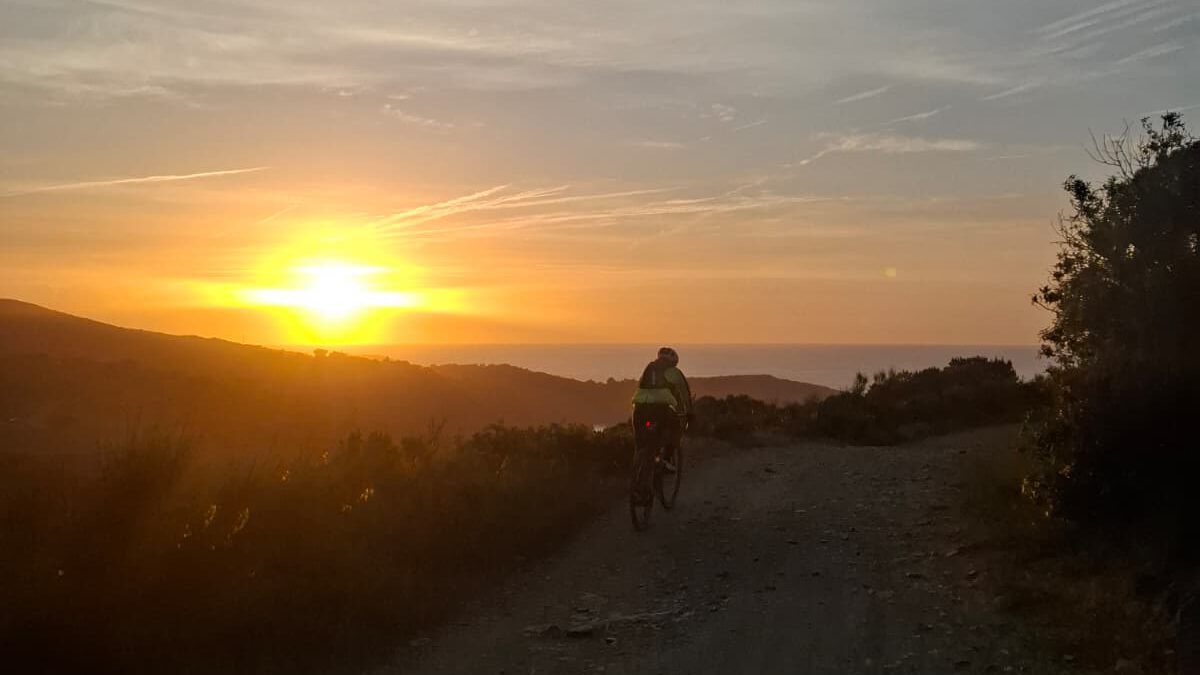
Recharged, I started into the night. This stretch of the route was familiar territory. It’s a beautiful area (though you see little of that at night) and it was predominantly downhill, which certainly helped. There were definitely moments where I questioned my decision not to sleep, but I had made things easy for myself. It had cooled down considerably at night and I had just barely enough clothing to stay comfortable while riding. There was no question of sneaking in a quick power nap somewhere, because I would certainly cool down too much, which wouldn’t do me any good. So I had very few choices to make, to keep on riding was the only option. In the early hours I cycled (or really, walked) through the nature reserve of Cap de Creus, one of my favourite places. I allowed myself to close my eyes for a moment while I had stopped to stow my jacket. That felt just a little too comfortable, and it wasn’t easy to break out of that comfort. The sunrise gave me an enormous energy boost and I felt a mental switch flip. I no longer really doubted whether I’d reach the finish, it was purely a matter of grinding through for ‘just a bit longer’ (about 10 more hours) and then it would all be done. In Roses I called my uncle and we had coffee together at the bakery while I tried to compensate for the calories I hadn’t eaten during the night.
From here the easier part of the route would come, nearly flat all the way to Girona with just one real climb left. I had been looking forward to that flat section for 350 km, but once it arrived it turned out to be perhaps the hardest stretch of the race. Physically it was fine, but mentally it was a challenge. Compared to those beautiful mountains, this part was just plain boring — long straight roads with very little to stimulate you. Maybe this was the flip side of demystifying things. In my head, this flat section would fly by. But even though you’re going much faster than in the mountains, the kilometres don’t add up. I started counting kilometres and hours in my head, which is something you should never do in endurance sports, everyone knows that. I was certainly not the only one who felt this way; I rode a stretch together with another guy and neither of us could wait until we finally reached that last climb. After 100 km of flat, the climb finally arrived. Relieved from the monotony of the plain, I attacked it far too enthusiastically. We also merged here with the Traka 200 participants and it gave me an ego boost to be surrounded by people and clearly not performing the worst. After sprinting up the mountain in the red zone for about 4 kilometres, I realised there were still 4 km to go, and that after that I still had 80 km to the finish. I backed off and dropped back into survival mode.
Just ‘getting through’ those last 80 km turned out to be a challenge once again. I keep being amazed by the mental effect of being ‘nearly’ at the finish. When you do a 100 km ride, the last 10 feel hard because you’re almost there. When you do a 560 km ride, you’re still perfectly fresh after 90 km — but apparently the same effect rears its head around the 500 km mark. I’d love to learn how that works, and more importantly how to avoid it, but on this day I unfortunately just had to deal with it.
After 34 hours I crossed the finish line back in Girona.
The atmosphere was wonderful and overwhelming — several friends had come to welcome me at the finish. Even though I appreciated it enormously, there was very little energy left to show it. I planted myself in a chair and could finally let the exhaustion in my body and head take over. It also turns out that after 34 hours of effort, very little of my Catalan remains.
The purpose of these challenges is to push myself and to feel appreciation for what I’m capable of. We are remarkably good at forgetting pain, and when I look back at the race I can mostly remember the moments of happiness. So it won’t be long before I need to start demystifying a new plan — in four weeks, to be precise.